Saturday, March 22, 2014
Space Opera - The Star
This week is all about Space Opera, and I read "The Star" by Arthur C. Clark.
And what a mind fuck this was.
"The Start", in a nutshell, is about how a Jesuit priest astrophysicist tries to cope with his now faltered faith, due to the fact that the same star that marked the birth of Jesus was the same star that killed off an entire planet of people that were extremely similar to the people of earth.
When I first finished the story, I had to reread the last page. I had never thought about faith in this way. It was a staggering realization, to say the least. Beside this mind blowing idea that the universe is linked together, what was interesting to me about this short story was the use of scientific terms. I've never been good at science, so reading the first page of this story was difficult to say the least. However, Clark does do a good job in taking the scientific terms and making them more understandable. By the end, I realized how big of a deal that was, and felt the same sense of loss and mind blowing realization that two separate worlds were so connected. That, although the feeling itself wasn't enjoyable, was what I enjoyed about the short story. It made me feel the hollowing loss of an entire planet and race. I've honestly never felt such emotions after reading a short story like the before. And that, I think, makes this story so successful, next to the plausibility of the two worlds being connected by this one supernova star. Just thinking about how an entire population was completely destroyed in order for the birth of one small child that would kick off the start of a religious movement that continues today is really mind blowing to me. And that caused me to think, "well, if that happened to them, that could most certainly happen to us!" even though it never factually happened. Just the possibility, the thought that something like that could happen and be intertwined with a whole other world is just....wow.
This short story definitely gives you something to think about, long after you've read this story.

Sunday, March 2, 2014
The Spiritual Education Part 2 - The Magicians
I enjoyed "The Spiritual Education" unit so much, I have two blog entries about two different books from this week.
So this blog post, I'm talking about The Magicians by Lev Grossman.
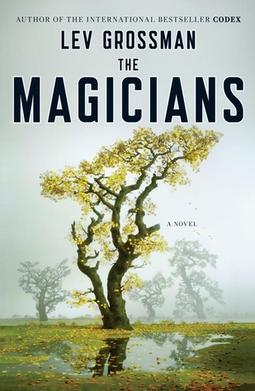
Very briefly, The Magicians is about a boy (Quentin Coldwater), who unknowingly is a wizard, and how he deals with learning that he's a wizard, that he is accepted to a prestigious wizard university, and all the problems that come with entering into the whole wizarding world...
Sound familiar? It should...since it sounds a lot like another popular book about a boy wizard, the Harry Potter series.
However unlike the HP series, The Magicians isn't as..happy and uplifting. If anything, it's a shocking dose of reality that most people don't hit until after college. Initially, I strongly disliked this book; I couldn't help but compare everything that I encountered in The Magicians to the HP series... thoughts such as:
"Harry found out about being a wizard way cooler then Quentin."
"Hogwarts is wayyyy better then Breakbills, especially since Hogwarts is British"
"The classes are wayyy cooler then those at Breakbills."
These were just a few of the many, many thoughts that crossed my mind while reading this book. However, after really getting into the book, I slowly started changing my mind about this book. At the end, it dawned on me why I started relating more and more to this book now, as an adult, then I probably ever did with HP as a child: it was based in reality.
While HP is truly an escapist series, in the sense that you're able to completely lose yourself and reality while reading the books, The Magicians is definitely based in a more truer reality. The setting is in a college, some of the problems Quentin faces while being at Breakbills were either very similar to my own experiences while in college or ones that I've seen my friends faced, and the way Grossman depicts the use and learning of Magic is more or less similar feelings I've had about certain subjects in both high school and college. Besides that, it's all the cold hard truths about growing up, maturing into an adult, and those realizations about oneself and the world surrounding them after learning said hard truths that really spoke to me, as a reader. The ultimate realizations that Quentin comes to at the end are feelings that I know many, many people have had after entering into the "real world"/business world.
All of these feelings are ones that I can either indirectly or directly relate too. HP, especially now as a young adult, I can't really say that I do. Perhaps that's maturity showing, or perhaps it's simply because I've changed since first reading the series; either way, after reading The Magicians I'm definitely more aware of the fact that I'm becoming an adult, and that I'm slowly, but surely, cutting off those ties to childhood. And honestly, I'm not too sure how I feel about it.
Saturday, March 1, 2014
Spiritual Education - The Golden Compass
This, is honestly what I've been waiting for in this class.
When I was younger, I absolutely love love LOVED the Harry Potter Series, as well as His Dark Materials (A.k.a. The Golden Compass Series). I mean, who wouldn't want a wand that could pretty much solve all your problems (cleaning, cooking..) and who wouldn't want their soul to be in an animal form for their entire life span? Especially for me, considering that for all of my childhood and most of my adolescent years, I was highly allergic to anything with fur and/or feathers. But I digress...
Witches. Daemons. Giant fighting polar bears.
That is the world of the Golden Compass.
I first read this series when, I believe, I was in either the third or fourth grade. It was the journey, the fighting, the action, and adventure to other worlds that drew me to these series like a moth.
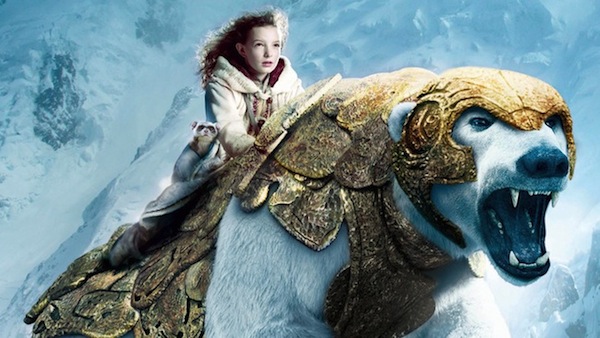
Since the third or fourth grade, I haven't revisited the series. However, I was curious to see how the more adult (since I still don't consider myself to be an adult adult) me would view the book.
Boy, was I surprised.
In the same theory that as children, we relate more to Jerry, from the popular animated TV series, Tom & Jerry, while as adults we relate more to Tom, His Dark Materials, I've found, work in the same way. When I was younger, I focused more on what Lyra had to say, and what she was thinking more so then the adults that she'd interact with. But as an adult, I've really started paying more attention to what the adults were saying and doing, rather then Lyra. The keyword here is "attention"... I'm not sure if it was because I was a child, or if I simply focused and remembered Lyra more, but when I reread the series, I found the adults more interesting then Lyra. A majority of that being due to the fact that I never realized what exactly the adults were saying, which completely blew my mind.
Elementary Particles, applied physics, dark matter... these are all common words and phrases that come up in this book series. Looking back, I'm not sure how I understood these very big and complex ideas. Maybe it was pure ignorance, maybe it was because I just accepted these ideas for what they were, ideas, but now as an adult...I'm shocked that I actually got through these books and understood them so well as a child. Now, while reading, it was harder for me to really grasp what they were saying, and even some of the scenes where these words were being focused on, I had to reread certain passages simply because it's harder for me to understand what's going on. Plus, I never actually realized how much religion plays in this series, it's amazing that I didn't realize it sooner. I wonder if the adults who've read these series as children, lose a certain quality that I can't really place my finger on. Perhaps it's like original sin, in that once we've eaten the apple of knowledge (as in, matured as adults) we gain one point of understanding, while losing another (see Adam and Eve's view of nakedness).
Saturday, February 22, 2014
Heroic Journey - Troll Bridge
This week was all about heroic journeys, and this week I chose to read Terry Prachett's short story called "Toll Bridge".
When I first started reading this story, I had so many preconcieved ideas about what was going to happen. Actually, before I even started reading the book, I figured "Oh, this will probably be just another story about a bridge troll", which it was..kind of. To quickly sum up the story, Cohen the Barbarian is en route somewhere when he encounters a troll family. That's pretty much the story.
Not at all what I was expecting.
I was expecting some sort of valiant battle between him and the troll, you know, something...more or less barbaric. But it wasn't. The troll, and his family, are facing hard times since not many people are traveling through, which means that he can't steal their gold, which therefore means he can't afford maintenance on his bridge. Because of all this, he's considered a lowly troll and not respected by his offspring (children? troll children? troll spawn??), his wife, or his extended family.
Again, this wasn't what I was expecting at all.
However, what I did enjoy was the realness of the story. What I mean by that is, the situation the troll is in, is something that I think many readers can relate to. The troll, Mica, is the type of troll who lives under a bridge, scares and/or kills people who try to cross his bridge, and take their gold. From what I understand from the reading, this type of troll "work", if you will, is a vocation that is very, very old; much like a carpenter or blacksmith, it's a very old vocation. However, times change and due to the changes around the area (more farms, less woods) not many people travel down towards his bridge, hence all his problems. All of this, reminds me of families that have generations of bakers, woodworkers, blacksmiths...a somewhat dying line of work. As time changes, there's a need to stray away from the old way of thinking, and start new endeavors, which means that their sons and daughters might not want to follow in the "family business". I think that's a concept that many, many people can relate to, even in this day and age.
Besides that, it was interesting to see where the short story lead, since it wasn't a traditional heroic journey. The traditional heroic journey, in a short summation, is basically when someone is called to go on a journey or quest, they go, they struggle, they may fail but get a second chance to succeed, someone important to them dies, and then they succeed and complete the journey or quest. In this story, the traditional heroic journey isn't really used. I feel like this short story would fall in between the time they decide to go on the journey and when they struggle. However, more then that, it's realistic. The troll faces problems, like I said before, that are very relatable to readers. And Cohen has to figure out how to maneuver his way around this problem. In the end, no one dies, and Cohen actually gives rather then takes from the Troll. It was an ending that I wasn't expecting and one that I really have never seen before. Was it a little anti-climatic? A bit. But, that is completely outweighed by the fact that the resoultion by Prachett is something I've never read before. And that was really, really refreshing. Plus, it motivated me to actually want to finish the story. All in all, it was just a really neat little short story that I just really, really enjoyed.
When I first started reading this story, I had so many preconcieved ideas about what was going to happen. Actually, before I even started reading the book, I figured "Oh, this will probably be just another story about a bridge troll", which it was..kind of. To quickly sum up the story, Cohen the Barbarian is en route somewhere when he encounters a troll family. That's pretty much the story.
Not at all what I was expecting.
I was expecting some sort of valiant battle between him and the troll, you know, something...more or less barbaric. But it wasn't. The troll, and his family, are facing hard times since not many people are traveling through, which means that he can't steal their gold, which therefore means he can't afford maintenance on his bridge. Because of all this, he's considered a lowly troll and not respected by his offspring (children? troll children? troll spawn??), his wife, or his extended family.
Again, this wasn't what I was expecting at all.
However, what I did enjoy was the realness of the story. What I mean by that is, the situation the troll is in, is something that I think many readers can relate to. The troll, Mica, is the type of troll who lives under a bridge, scares and/or kills people who try to cross his bridge, and take their gold. From what I understand from the reading, this type of troll "work", if you will, is a vocation that is very, very old; much like a carpenter or blacksmith, it's a very old vocation. However, times change and due to the changes around the area (more farms, less woods) not many people travel down towards his bridge, hence all his problems. All of this, reminds me of families that have generations of bakers, woodworkers, blacksmiths...a somewhat dying line of work. As time changes, there's a need to stray away from the old way of thinking, and start new endeavors, which means that their sons and daughters might not want to follow in the "family business". I think that's a concept that many, many people can relate to, even in this day and age.
Besides that, it was interesting to see where the short story lead, since it wasn't a traditional heroic journey. The traditional heroic journey, in a short summation, is basically when someone is called to go on a journey or quest, they go, they struggle, they may fail but get a second chance to succeed, someone important to them dies, and then they succeed and complete the journey or quest. In this story, the traditional heroic journey isn't really used. I feel like this short story would fall in between the time they decide to go on the journey and when they struggle. However, more then that, it's realistic. The troll faces problems, like I said before, that are very relatable to readers. And Cohen has to figure out how to maneuver his way around this problem. In the end, no one dies, and Cohen actually gives rather then takes from the Troll. It was an ending that I wasn't expecting and one that I really have never seen before. Was it a little anti-climatic? A bit. But, that is completely outweighed by the fact that the resoultion by Prachett is something I've never read before. And that was really, really refreshing. Plus, it motivated me to actually want to finish the story. All in all, it was just a really neat little short story that I just really, really enjoyed.
Saturday, February 15, 2014
Witches - Fair, Brown, and Trembling
This week was all about Witches, and I read the short story "Fair, Brown, and Trembling" from Ireland by Jeremiah Curtin.
I've read many, many versions of cinderella before, from all across the world. What made this particular version different and more interesting was the fact that the story continues after Trembling, who is Cinderella, and her prince charming find each other and get married. It continues all the way until her daughter is grown up. That, was pretty interesting and something that I haven't seen much in a Cinderella story. Besides that, it focuses less on story before Trembling was treated unfairly, which was refreshing too. It was also interesting to see that her prince charming actually had to fight for her love, which is something that I definitely haven't seen before in any Cinderella story that I've read (or, at least that I can remember). All in all, it was a good, interesting, and refreshing take on the classic, but over written story of Cinderella.
Sunday, February 9, 2014
The New Weird - Donnie Darko
This week, we talked about the "New Weird".
I honestly wasn't sure what to think about this genre of literature, since it's like a mix of horror, but with a tinge of something else.
Instead of doing a reading, I decided to watch the movie "Donnie Darko". This particular movie has been in my "to watch" list for quite some time now, especially since so many of my friends have been ranting and raving at how good it is. I had a small idea of what the movie was about...a teenage boy and his freaky looking, imaginary demonic bunny. That was about it. But, I had an open mind to it. So, I settled down and watched it, unsure of what to expect.

From our teacher's blog, the definition of the "New Weird" is as follows: "The term evokes the old Weird Tales Magazine, a pulp magazine in which a range of stories appeared dramatizing uncanny experience, tales of the monstrous, or experiences with the supernatural."
Well, in Donnie Darko's case, this film would probably fall under "tales of the monstrous". I had literally no idea that this film focused on a kid with more then one mental illness. And it came as such a huge shock that he didn't actually live the life in the film, he only imagined it (not to give any spoilers aways). For me, the monstrous part of "tales of the monstrous" isn't Donnie and it isn't his obviously decline in mental health; I think it's all the connections that the movie sets up and makes, which is why it might be considered the "New Weird".
One of the more interesting connections the movie makes is with Roberta Sparrow. The first time I watched it, I would have never guessed that the crazy old lady that we encounter is a major, important role in this story. After finding a book about time travel, and really getting into the theories of it, Donnie, from another person, learns that the crazy old lady us viewers encounter no less then 10 mins into the movie is so important, since she wrote the book that Donnie is so interested in. I honestly did not see that one coming, perhaps because I enjoyed the story too much or whatever. But when it's finally revealed, it's like, whoa, it all makes sense now.
But, then again, so much in the film is just weird; however, I must say that I really did enjoy this film, and was very glad I watched it.
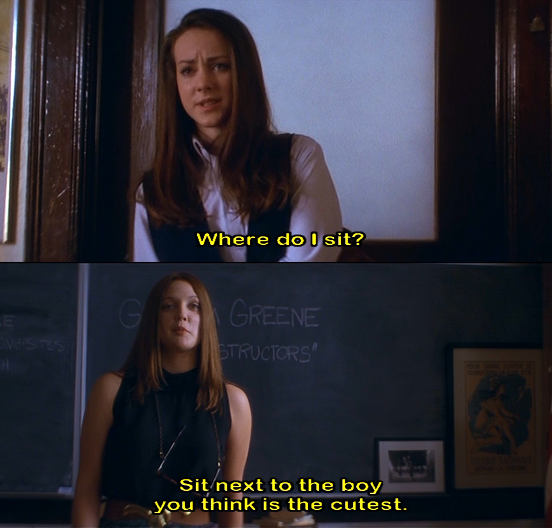
One last thing: who knew Drew Barrymore was such a hottie in this film?
Saturday, February 1, 2014
J-Horror
I'm as complex as any J horror story.... I like classic gothic literature, but I can't stand straight up horror (Stephen King...I'm looking at you, sorry..); I enjoy a few dark, primarily "horror" TV shows such as Dexter and Hannibal, but when it comes to horror films such as the Saw Series and even Paranormal Activity, count me out!
So it wasn't a huge surprise that I'm not the biggest fan of "J - horror". I read "Battle Royal", the manga version, and needless to say, I wasn't that interested. I'm not sure if it's because that idea of "lets see who's the most intelligent and creative through a game where pretty much everyone except the main character dies" or if it's because I relate "Battle Royal" to the American novel "The Hunger Games" but either way, I didn't get very far into either book.
Now, when I say I don't like it, I have specific reasons, mainly due to the storyline/plot of said novels. However, with "Battle Royal", there's at least one thing that I enjoyed while reading, if only for a brief time, and that was the fact that it was a graphic novel.
I grew up reading manga, mainly because my older brother read them but that's a completely different topic of discussion, and I do have a certain appreciation for it. Inuyasha, .Hack, and many, many other manga books, are just a few of the many books I either stole, or owned myself. The reasons I liked them when I was younger are still true now, 8 or so years later: they have pictures. Despite the fact that many of the manga didn't have color, that was completely irrelevant, simply because they had pictures. Unlike many of the other comics I enjoyed, Calvin & Hobbs, Garfield, The Peanuts Gang & Snoopy to name a few, Manga's pictures weren't set in regulated and consistent boxes; the layout of the pictures really moved and flowed with the novels. When there was something big or important happening, like a defeat of a major enemy or the death of someone, usually that took up an entire page. However, while taking up an entire page, the image was almost always drawn with more detail in the environment the character was in. Besides that, there was variations in the shape and size of the frames throughout the whole novel, as well as sometimes the frames even blended into each other. Considering all the differences from traditional American comics, it wasn't a big surprise when I started liking and reading Manga with the same zest as regular novels; just the smaller changes in the layout really made all the difference in whether or not I liked manga as a genre.
Subscribe to:
Posts (Atom)